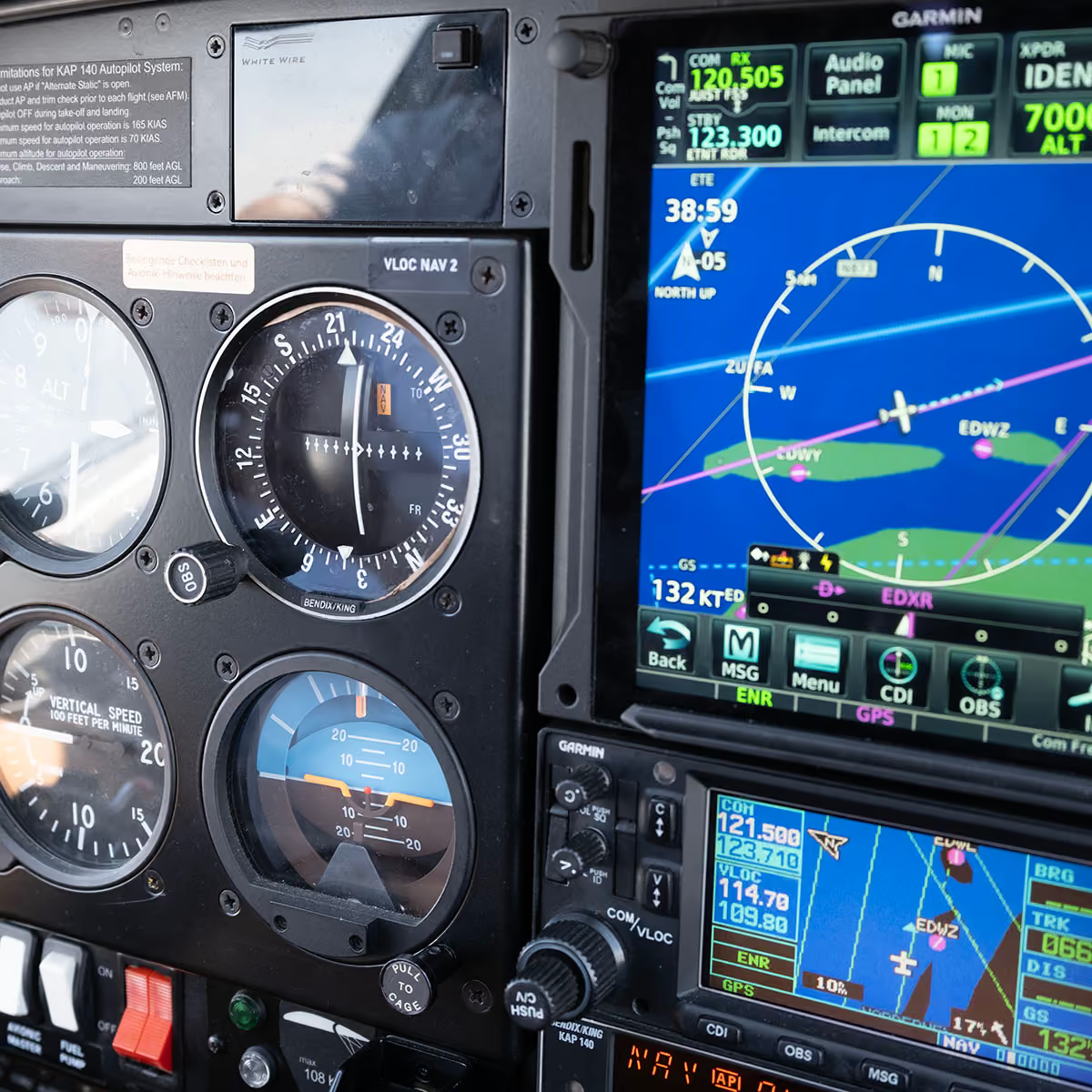
More than 100,000 Sentry receivers have now made their way into aircraft cockpits around the world, helping pilots stay aware of changing weather, nearby traffic, and potential hazards in flight. In some cases, they’ve even provided information that could save lives.
Here's a look at how Sentry came to be and the partnership that made it possible.
The perfect partnership
Sentry is the result of a collaboration between three companies with a shared understanding of general aviation. ForeFlight brings the software and flight-planning experience, uAvionix provides the hardware and avionics expertise, and Sporty’s brings decades of experience working directly with pilots through product distribution, testing, and customer support.
The three companies shared a common goal: make useful technology more accessible and practical for GA pilots. So when an opportunity emerged in the early 2010s to bring subscription-free datalink weather to general aviation, it was a natural fit.
Bringing real-time weather to the cockpit
The FAA was proposing a nationwide network of ground stations broadcasting radar, METARs, and Temporary Flight Restrictions (TFRs). For pilots who relied on weather information gathered before departure, the possibility of receiving updated information in flight was exciting. As John Zimmerman of Sporty’s recalls, the initial reaction was almost one of disbelief: “You mean we can just tune into 978 MHz and get 5-minute-old weather?”
“Once we verified the signal was there, the real challenge began; building a receiver small enough for a tight general aviation cockpit and displaying that data cleanly on an iPad,” John remembers. “It took serious engineering, but the payoff for pilots has been worth it.”
Building something pilots could rely on
Portable ADS-B receivers were becoming an increasingly important tool for pilots flying beyond the traffic pattern. And as the technology developed, so did pilots’ expectations. Early portable receivers generated plenty of feedback and feature requests. Pilots wanted more information, greater reliability, and equipment they could move between aircraft without complicated installation or set-up.
The experience needed to be simple enough that pilots could focus on flying rather than managing another piece of equipment. That meant no unnecessary wires, no complicated installation, and just one button to operate it.
“Building good hardware and good software wasn’t enough,” John explains. “Sentry had to work seamlessly from the moment you unboxed it to the final approach on a long cross-country.”
Behind the hardware
We weren’t setting out to build just another portable ADS-B receiver. Our goal was to set a new benchmark for what pilots could expect from one.
Three challenges shaped the initial development of the Sentry family: smaller size, all-day power, and innovative safety features.
Smaller size
The receivers, Wi-Fi, internal antennas, GPS, and sensors needed to fit into a compact enclosure while maintaining our goal of industry-leading reception. Antenna placement and electronics layout mattered as much as the case itself. The unit also needed a proven, secure suction mount that wouldn’t interfere with the pilot’s view.
All-day power
Longer battery endurance meant making better use of every milliwatt and millimeter of space. uAvionix and ForeFlight worked together to reduce power consumption across the electronics, processing, and communications with the app.
Pilots without access to aircraft power needed a reliable internal battery. Instructors and commercial pilots needed to fly consecutive flights without recharging. Sentry and Sentry Plus also needed to keep their attitude sensors operating in the event of an avionics failure.
Innovative safety features
Integrated carbon monoxide (CO) monitoring required turning raw sensor data into a reliable warning a busy pilot would notice and could act on before exposure reached dangerous levels. Precise detection thresholds, audible alarms, visual indications, and ForeFlight alerts had to work together.
The internal AHRS in Sentry and Sentry Plus also supports ForeFlight’s Reported Turbulence feature, making automatically measured flight conditions useful to other pilots worldwide.
Sporty’s customer support and aviation training expertise helped ensure these design decisions reflected the needs of pilots. Those decisions then had to prove themselves in flight.
Putting Sentry to the test
At ForeFlight, that meant putting Sentry through extensive flight testing across a wide range of aircraft and operating conditions.
Every new Sentry model starts with a list of aircraft we still need to test it in. A receiver that works perfectly on the window of a Cessna 172 has to perform just as well in a Citation at the flight levels, and the only way to know is to go fly it.
So we work our way through pistons, turboprops, and jets, then do it all again when something changes. The flying itself is rarely routine. Validating the sensors means steep turns, slow flight, repeated climbs and descents, racetracks and box patterns, and a lot of time in the same block of sky before landing back where we started. We've had some very patient controllers over the years.

Much of what goes into developing a Sentry happens far from an engineering lab. It looks like a few of us around a table at an FBO, sweating through our shirts in August, with a soldering iron and laptop while the airplane sits on the ramp.
Pilots walking past give us a look. We make a change, button it up, fly another leg, land, and open it again.
It's where we work through the details pilots might never notice, like how quickly Sentry picks up GPS, whether the CO alarm can be heard through a headset, how far out traffic appears, and how the AHRS performs.
When Sporty's product testers landed after their first flight with Sentry, the response was unanimous: it belonged in every pilot's flight bag. One of the toughest testers summed it up: "This is a big deal."
100,000 receivers later, the goal is still the same: turn it on and forget it's there.
From the first Sentry to 100,000
When Sentry launched in 2018, it combined several capabilities that previously required separate pieces of equipment. Alongside ADS-B weather and traffic, it included GPS, backup attitude information through an internal AHRS, and a built-in carbon monoxide detector and alarm. The original Sentry also offered improved battery life and weather replay capabilities in a compact design.
As the Sentry lineup grew, Sentry Mini offered a smaller, externally powered option for pilots who wanted essential ADS-B weather, traffic, and GPS capabilities.
Sentry Plus took the original Sentry a step further, building on its capabilities with an integrated display, significantly longer battery life, and flight data recording. These improvements made Sentry Plus an even more capable option for pilots looking to get more out of their portable ADS-B receiver.
Through it all, the goal has remained the same: give pilots useful information without making flying more complicated. Feedback from pilots using Sentry every day has helped shape each generation, from practical design improvements to new capabilities that make a difference in the cockpit.
The stories behind the numbers
Some of the most memorable stories we’ve heard are from pilots who relied on Sentry to help them make critical decisions.
John recalls a Piper Cherokee pilot who experienced an attitude indicator failure just as they entered instrument meteorological conditions (IMC). With the aircraft’s primary instrument no longer available, the pilot used Sentry’s backup attitude information displayed on an iPad to help descend safely into visual conditions.
Another pilot discovered a potentially dangerous carbon monoxide leak after Sentry’s audible alarm sounded. Without that warning, the problem might have gone unnoticed and developed into a life-threatening emergency.
Of course, Sentry’s value isn't limited to emergencies. For most pilots, it's the information they use on every flight, whether they're flying a familiar route or heading somewhere new.
Testimonials
100,000 receivers, and counting
Reaching 100,000 Sentry receivers wouldn't have been possible without the people behind the product. From the engineers and product teams at uAvionix to the developers and aviation specialists at ForeFlight and the team at Sporty's, it's been a shared effort from the beginning.
And just as importantly, thousands of pilots have put their trust in Sentry, recommending it to fellow pilots and making it part of their everyday flying.
Traffic awareness has also been getting more attention in the U.S., where lawmakers are considering new ADS-B In requirements aimed at helping pilots better see nearby aircraft. It’s a conversation that hits close to home for us. Making traffic information more accessible to general aviation pilots has been part of Sentry’s purpose from the beginning.

Behind each of those 100,000 receivers is a pilot who has another source of information available when it matters most.
To everyone who has been part of this journey, thank you. Here's to the next 100,000.