Ever wondered what goes into your aviation insurance quote or what you can do to potentially lower premiums?
Underwriting is the process of determining your premium - or if you’ll even be offered coverage - based on your application. It looks at a range of factors related to you, your aircraft, and how you plan to use it. Understanding what goes into that process can make insurance quotes feel less like a mystery and help you better understand how your own pilot profile influences your coverage options.
How do underwriters calculate aviation insurance premiums?
As with any kind of insurance, aviation insurance underwriting is all about risk. Underwriters use historical data, industry experience, and risk models to estimate the likelihood and potential cost of future claims. The aim isn’t to reward or penalize individual pilots, but rather to classify their risk based on the insurer’s past experience with similar pilots. We’re often asked whether one-off discounts are available for unique circumstances or additional training, but those discounts are rare unless insurers have enough data to show that they lead to fewer claims.
Two pilots flying the same aircraft may receive different quotes based on differences in their experience levels, ratings, or claims history. Similarly, the same pilot may also receive very different quotes depending on the aircraft they’re insuring.
While insurers consider many of the same factors when evaluating risk, they don't necessarily weigh them the same way. One insurer may place more emphasis on a pilot's recent flight experience, while another may focus more heavily on the aircraft being insured.
So, which factors have the biggest impact on aviation insurance premiums? Let's start with what underwriters typically consider.
What factors affect aviation insurance premiums?
Several factors go into assessing your risk when you apply for an aviation insurance quote. While each insurer may weigh these factors differently, the following are some of the most common considerations.
Pilot experience
One of the first things underwriters typically consider is your flying experience. Total flight time is an important factor because it generally reflects your overall exposure and experience. However, underwriters usually look beyond the headline number. Factors they commonly consider include:
- Total flight hours
- Flight hours in make/model
- Recent flight experience
- Certificates and ratings
- Instrument proficiency
- Training history
Consider two pilots. Pilot A has 1,500 total hours but has only logged 10 hours in a newly purchased high-performance aircraft. Pilot B has 800 total hours but 300 hours in that same aircraft type.
Although Pilot A has more overall experience, Pilot B may represent a lower risk in that particular aircraft. Every aircraft handles differently, and accident data often shows elevated risk during transition periods. That’s why time-in-type is particularly important.
Recent flight experience
Experience isn’t just about your total flight hours. It’s also about what you’ve done recently, especially in the last 12 months. If you fly regularly throughout the year, you may be viewed as more proficient than someone returning to flying after a long break.
Recency is one of those metrics weighed very differently by each insurer. Some weigh it heavily while others don’t even ask for it as part of your application. It comes down to whether each of these insurers finds a meaningful correlation with recency in their loss data.
The aircraft itself
The aircraft you fly also has a significant impact on your insurance pricing in several ways:
Aircraft value
One of the most influential factors is aircraft value, also known as hull value, which represents the amount the aircraft is insured for. Clearly, replacing or repairing a more valuable aircraft costs more. A $60,000 trainer and a $5 million turbine aircraft represent dramatically different potential claim exposures. That’s why aircraft value tends to be one of the strongest drivers of premium calculations across the aviation insurance industry.
However, the relationship between aircraft value and premiums isn't always straightforward. The type of aircraft, whether it’s technically advanced, and the year it was manufactured can all play into both your aircraft’s value and how it affects your premium.
Aircraft complexity
The aircraft’s design, equipment, and performance characteristics also make a difference. Factors may include:
- Landing gear type (fixed, retractable, or conventional)
- High-performance capabilities
- Turbine versus piston powerplants
- Advanced avionics systems
More complex aircraft often require more training, place greater demands on pilot proficiency, or involve higher repair costs.
How you use the aircraft
Underwriters look at whether you’re using the aircraft for personal and recreational flying, flight training, business use, commercial operations, or aircraft rental activities. If you use an aircraft occasionally for personal cross-country trips, they’ll view it differently than one conducting frequent flight instruction, for example.
Aircraft used for commercial purposes will generally attract higher premiums than the same aircraft used for recreation, since the former tend to fly more hours and have greater liability exposure, especially when they carry passengers.
Claims history
Just as a clean driving record can earn you lower auto insurance pricing, your aviation claims history can influence how your risk is evaluated. Underwriters may consider:
- How many claims you’ve made
- The severity of losses
- How recently the claims occurred
- The circumstances involved
If you’ve had to make a claim in the past, it doesn’t automatically prevent you from getting insurance coverage. But your claims history does provide useful context during the underwriting process.
What the aviation insurance data shows
To better understand which factors have the greatest impact on aviation insurance premiums, we analyzed thousands of insurance policies submitted through the ForeFlight Fair Price Tool. We looked at how different aircraft and pilot characteristics influenced estimated premiums and which factors had the greatest overall impact.
The results revealed some expected trends, along with a few surprises. Aircraft value emerged as the most influential factor, followed by landing gear type. Pilot experience, aircraft manufacturer, and age also played a role, although their influence varied.
The chart below shows which factors had the greatest overall influence on estimated premiums in our analysis.
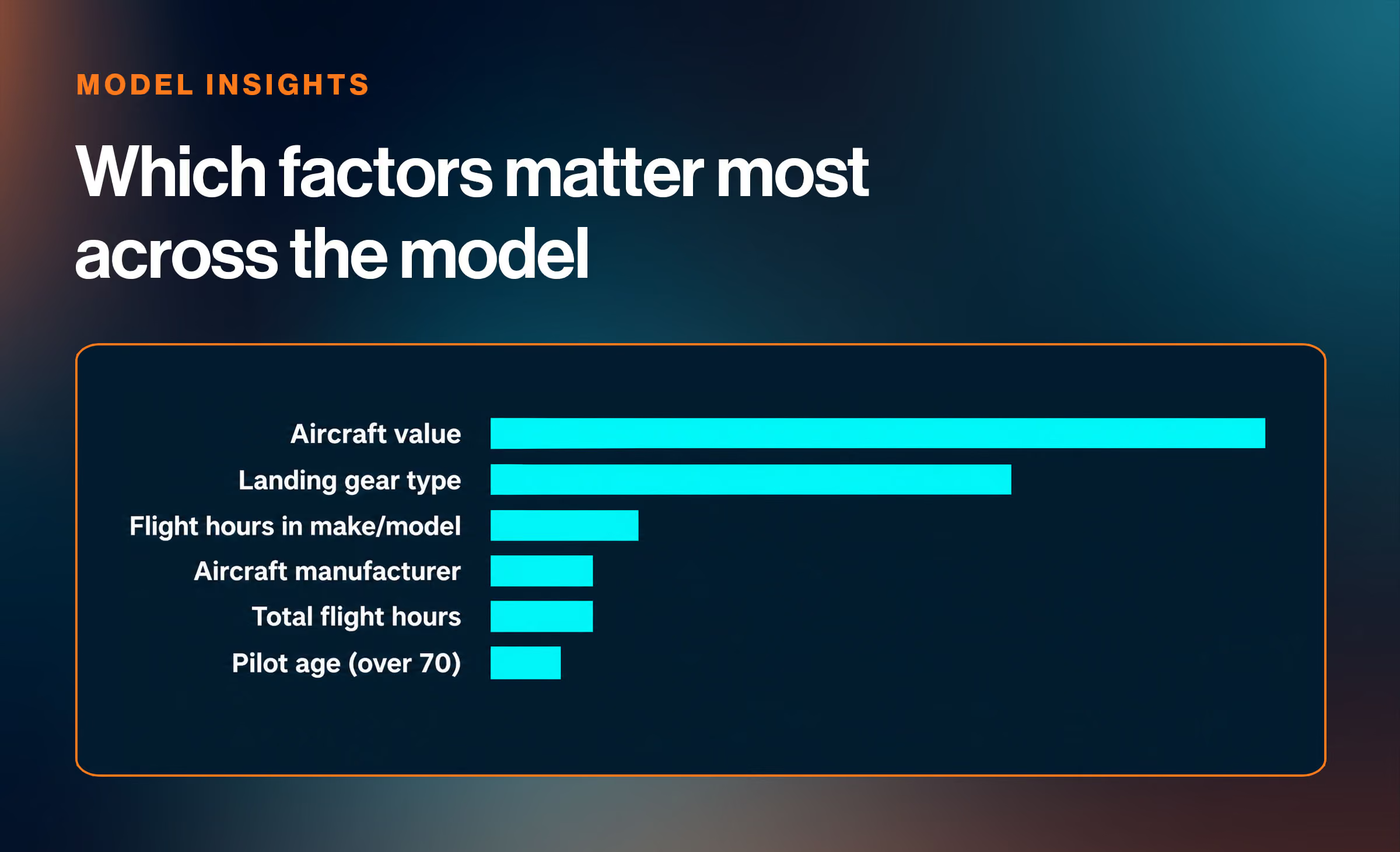
Many of these factors are also related. For example, aircraft value and manufacturer can be connected, since certain manufacturers produce aircraft that tend to be more expensive to insure. That's important to keep in mind when looking at how individual factors influence estimated premiums.
Aircraft value
Unsurprisingly, aircraft value emerged as the most important factor. There's a big difference between insuring a $5 million jet and a $50,000 trainer, though perhaps not as big as you'd think. We've seen an aerobatic biplane valued under $50,000 fetch a $6,000 premium, while a multimillion-dollar jet came in at $17,000. It's a good reminder that aircraft value isn't the only factor influencing your premium.
Landing gear type
Landing gear type ranked second in our analysis, ahead of several pilot experience measures. Retractable- and conventional-gear aircraft were generally associated with higher estimated premiums, while fixed tricycle-gear aircraft tended to push estimates lower.
This reflects differences in aircraft design, operating characteristics, repair costs, and of course, claims likelihood. Gear-up landings in retractable-gear aircraft and ground loops in conventional-gear aircraft account for a significant number of claims. As a result, these aircraft are generally more expensive to insure, especially for pilots with limited experience flying them.
Experience
Pilot flight hours and time in make and model were also important contributors, although they ranked below aircraft value and landing gear type. Generally, higher total flight time was associated with lower estimated premiums.
However, the relationship wasn't perfectly linear. Additional flight hours didn't necessarily have the same influence at every experience level, reinforcing why underwriters consider multiple aspects of a pilot's experience rather than total hours alone.
Pilot age and claims history
Our analysis also found that pilot age above 70 and prior claims history tended to increase premiums. That doesn't mean you can't get insurance if you're over 70 or have previous claims. It just means you may face higher premiums because of the additional risk insurers associate with those factors.
Claims history isn't included in the chart above because it has no impact for the majority of pilots who don’t have claims However, for pilots who have had a claim in the last five years, its impact would rank third in our analysis, behind aircraft value and landing gear type.
For pilots over 75 who already have coverage, we generally recommend renewing with your current insurer. Insurers account for the longevity of your relationship with them when determining premiums and coverage amounts. Each insurer treats pilots differently as they age. Some welcome new business from pilots over 75, others may shy away or avoid older pilots in retractable-gear aircraft. One insurer requires pilots 85 or older to fly dual-only. Nevertheless, insurers don’t want to be the reason you hang up your wings and neither do we. We’ve helped insure pilots well into their 80s.
How these factors work together
While it's helpful to look at each factor individually, aviation insurance premiums are influenced by a combination of characteristics. For example, an aircraft's landing gear type might push its predicted premium higher, while a pilot's flight experience could help offset some of that increase.
This helps explain why two pilots seeking to insure similar aircraft may receive different quotes.
What to keep in mind about the analysis
These findings reflect patterns across thousands of historical insurance policies, rather than the pricing decisions of any one insurer. Each insurer evaluates risk differently, so the factors that influence your actual quote may vary. While the analysis helps show which characteristics are associated with higher or lower premiums, those relationships don't necessarily mean one factor directly causes a change in price.
Transparency helps pilots make better decisions
Aviation insurance pricing isn't always straightforward, but understanding what goes into a quote can help explain why premiums vary so much from one pilot to the next.
Whether you’re purchasing your first aircraft or reviewing coverage for renting one, understanding how underwriters evaluate risk can help you set realistic expectations. ForeFlight Insurance is designed to make that process easier to navigate by giving you access to multiple coverage options through a straightforward, pilot-focused experience.
Have questions about aviation insurance? Contact insurance@foreflight.com or schedule a no-obligation phone consultation here.